I really enjoy hackathons and all sorts of random competitions. I love the feeling of being fully focused on solving a challenge. It is a pity that most of them are mainly designed for university students.
For some of the competitions I took part in, I no longer have much evidence or documentation, but I can still recall the experiences, thankfully.
Hackathons
- What is this EBEC thing?
- EBEC Porto 2019
- PwC Challenge
- SciTech 2019
- YML Hackathon - IKEA
- EBEC Porto 21 as an Organiser
- BEST IT Competition 2021
- EBEC Porto 22 as an Organiser
- EBEC Iberia as an Organiser
- EESTEC Challenge Porto 2022
- EBEC Porto 23 as an Organiser
- Datattack 2023
- 6th Cassini Hackathon
- Hackacity 2023 - Smart City Data Challenge
- Media Dive - Aveiro Tech City
- Museum of Modern Algorithms
What is this EBEC thing?
EBEC stands for (or used to stand for) European BEST Engineering Competition. It is organised by BEST, which in turn stands for Board of European Students of Technology. It is a student organisation spread out through Europe with hubs in lots of different countries, from Estonia to Portugal.
EBEC follows a pyramid structure: each local hub hosts its own challenge, with winning teams advancing to a national round and, ultimately, the European final. The competition maintains a standard format across Europe:
- 24 hours
- 2 challenges (1 per team):
- Case Study: coming up with solutions for a set of 2 problems (business, logistics or environment related).
- Team Design: building a physical prototype to solve a certain problem, according to a set of restrictions.
While the format evolves each year based on BEST’s financial resources and other factors, EBEC Porto consistently stands out. It remains the largest engineering competition in Portugal, attracting more than 250 participants annually.
I first participated in 2019, in Team Design, and I had such a great time that I joined BEST and helped organise four more editions of the competition, which is why EBEC shows up so often in this section.
EBEC Porto 2019
This was my very first hackathon experience, competing in the “Team Design” category. The challenge: build a physical device to raise a flag by 50 cm, inspired by a Rube Goldberg machine. The rules included:
- The device had to be triggered by a ping pong ball dropped from 5 cm.
- It needed at least five distinct mechanisms (e.g., dominoes, levers, pulleys) to raise the flag.
- The build had to fit within specific dimensions.
- All materials had to be “purchased” from the event’s store, with fewer credits spent earning a higher score.
- Other rules existed, but I don’t remember them.
Judging combined objective criteria (such as the number of manual interventions required) and subjective ones (like creativity and originality).
Our team built a boat-like structure with a central mast for the flag. Each deck housed a different mechanism, creating a chain reaction to lift the flag. It was a blast to design and assemble, even though we didn’t win.
The biggest lesson I took away: I was surprised by how much could be accomplished in such a short time (just 24 hours). The time pressure forced intense focus and creative problem-solving, something I’ve come to love about hackathons ever since.
PwC Challenge
Business case challenge focused on a fictional cereal brand in the European market. Our team received background information and was tasked with developing a strategic plan for the brand’s future. The format was engaging: we were confined to a room for two hours, without internet access, and had to prepare our presentation using only paper sheets.
Although we didn’t win, it was a valuable introduction to business case studies and strategic thinking under pressure.
SciTech 2019
This event closely resembled EBEC Porto 2019, but compressed into just 3 hours. The challenge: build a device to launch a frisbee as far as possible (distance test), followed by a precision test to pass through a target. The main rules were:
- Only materials from the event store could be used, with the same credit-based system.
- The device had to fit within specified dimensions.
- Direct contact with the device was only allowed to trigger the launch.
- Teams did not have access to the actual frisbee during construction.
Most teams opted for spring or clever lever mechanisms. My team took a different approach, using a big stick to whack the frisbee. Simple, but surprisingly effective, as ours achieved the greatest distance. Unfortunately, we were disqualified for “allegedly” touching the device an extra time by accident, which was disappointing.
Interestingly, every team failed the second (precision) challenge, making for a very funny conclusion.
YML Hackathon - IKEA
This hackathon was more of a business-oriented project, with no actual “hacking” involved. Sponsored by IKEA, the challenge focused on analysing their operations in Portugal and proposing strategies to increase revenue.
Our team examined IKEA’s online business, comparing the order process, shipping options, and pricing with those of competitors. One particularly odd finding was that “Click & Collect” at a store was more expensive than home delivery, whereas competitors maintained consistent pricing for both options. The IKEA representatives were not impressed by our criticism of this policy.
Although we did not win, it was an enjoyable opportunity to tackle a business-focused challenge.
EBEC Porto 21 as an Organiser
2021 was still during Covid. EBEC 2020 had been cancelled just three days before it was supposed to start, which left everyone pretty demotivated and led to a big drop in participation. I had joined BEST a few months earlier, after really enjoying my experience as a participant in 2019, and decided to apply for “Topic Responsible” (one of two). That meant I was in charge of everything related to the technical challenges:
- Coordinating the team that developed the Case Study (CS) and Team Design (TD) topics;
- Writing all the documentation (guidelines, problem statements, evaluation rubrics);
- Preparing backup topics in case there were no external partners for CS or TD.
With everyone stuck at home, building physical prototypes was impossible. We considered delivering materials to participants, but it just wasn’t feasible. So, we switched to a CAD (Computer-Aided Design) format, judging based on 3D models and more subjective criteria. This brought new challenges: only students from Mechanical or Civil Engineering usually had CAD experience, and I didn’t know it myself. I had to learn the basics quickly, but most participants already had some CAD skills so that problem was easier to solve than expected. The challenge we set was to design a spacecraft for collecting space debris. The spaceship theme worked surprisingly well given the circumstances as the participants gave positive feedback.
Unfortunately, hosting the event during Covid made it challenging to keep participants engaged for a full 24 hours online. Virtual formats just aren’t as engaging. To help break up the monotony and boost morale, we included interactive sessions like a Zumba class and other fun activities during the competition.
BEST IT Competition 2021
The objective of the competition was to develop a project that would assist individuals with disabilities. Each team was allocated a budget of €100 to spend on electronic components, and the event followed a 48-hour format.
Our team created a prototype designed to help blind people navigate without the use of a cane. The device utilised a distance sensor mounted on two servo motors to scan the environment, functioning somewhat like a rudimentary LIDAR system. When an object was detected within a specified range, an array of buzzers emitted a beep, indicating the position of the nearest obstacle. The volume of the beep increased as the object drew closer.
Although we did not win the main competition, we did secure victory in the mini meme contest. The event took place during the Covid pandemic, and I suspect I may have contracted the virus by the end. Not ideal…
EBEC Porto 22 as an Organiser
Due to some administrative issues at my university, I was supposed to go on Erasmus in 2021 but had to cancel it. By then, there were no longer any interesting roles available at BEST, so in October 2021 I decided to re-apply as a “Topic Responsible.” This time, the challenge was most likely going to involve building a physical device, although we were not completely certain at first.
Fortunately, we were allowed to host the competition at FEUP, but strict health measures were still in place and everyone had to wear face masks. Masks were only lifted a few weeks after the competition ended. It was a strange period because most of the people who had previously organised a live edition of the competition had already left the organisation, taking much of the accumulated knowledge with them. As a result, we had to figure out most things ourselves, which was especially challenging given that the competition involved more than 200 participants.
The Public Relations department of BEST secured a partnership with a company called Switch, which wanted to sponsor the topic. Switch developed portable ATM software, so we proposed designing an ATM as the final challenge. In the middle of preparing the topic, we learned that Switch had been acquired by another company, Saltpay, which has since been acquired by yet another one, Teya. Fortunately, Saltpay kept the same challenge. The task for participants was to build a device where users could select an amount to withdraw and, after inserting a “credit card,” receive that amount in “Saltpay Bucks” and “Saltpay Coins.”
You can look at the competition guide here.
Before the competition began, we had to present the topics to give participants an overview of what was planned. I made a big mistake during that presentation: I strongly encouraged every team to use electronic components and reassured them that they did not need to worry because I would personally help with any issues. That day I learned how powerful it is to be on a podium because people really take your words seriously. From the moment the 24-hour challenge started, I was overwhelmed with questions, technical issues, and complaints about the quality of the materials. However, I also discovered how rewarding it is to help. Participants were extremely grateful whenever I fixed their problems, and to them it felt almost magical, like when I simply changed the bootloader settings on an Arduino and suddenly their project worked.
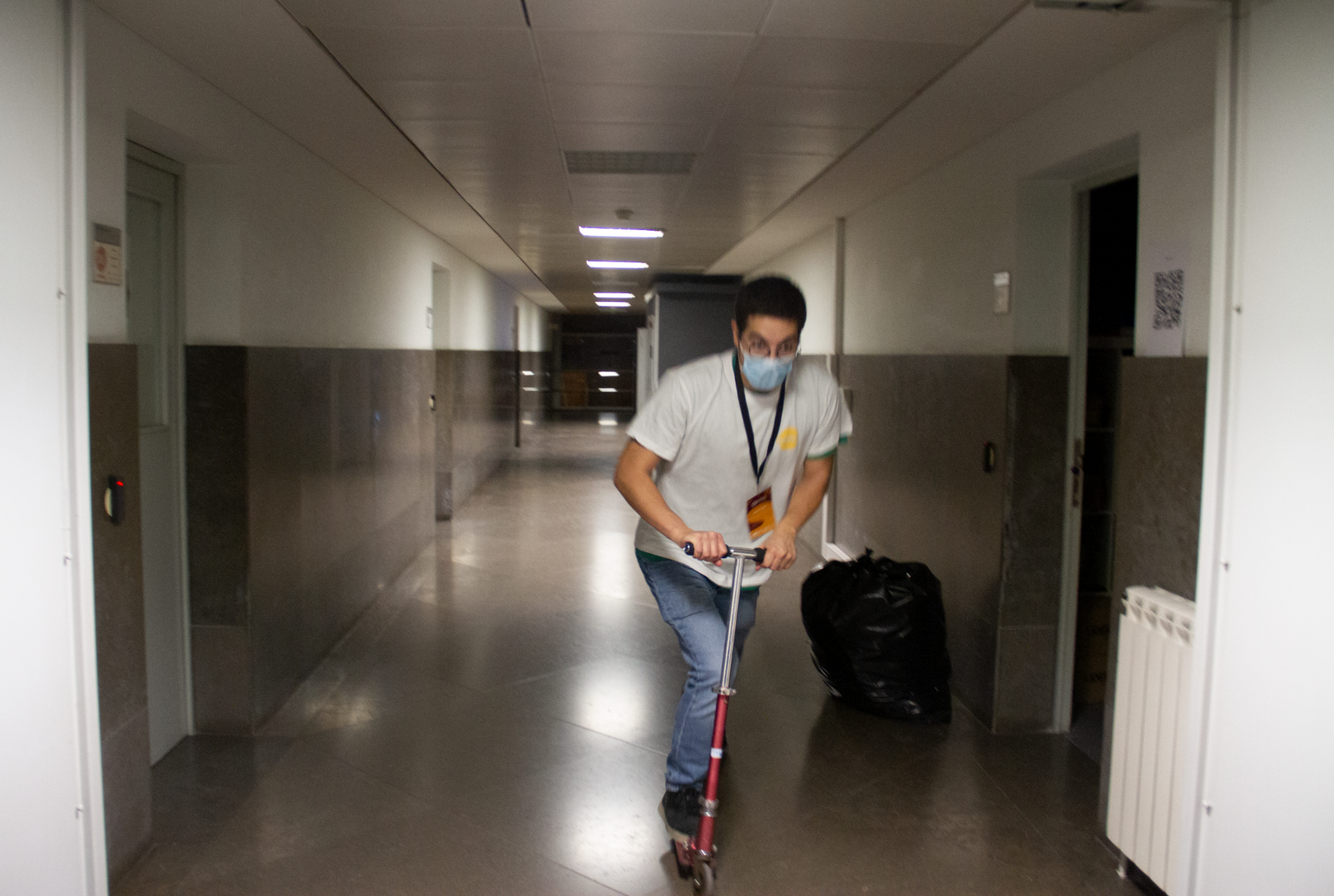
During the competition, it was complete chaos. I was constantly running from room to room answering questions, fixing broken circuits, gathering organisers to clean up, reminding participants to follow the rules, and asking them to keep their masks on. I did not even have time to join the yoga class, which was quite sad.
The topic turned out to be much harder than we had expected, and many teams quit before the competition was over. Some did not even show up for their presentations, which meant they were disqualified. I am fairly sure the main reason was that they could not get the electronics to work and eventually gave up. Ironically, the winning team used no electronics at all.
I really enjoyed this experience and could write much more about it, but it would be too lengthy for this page.
Here is me having fun:
EBEC Iberia as an Organiser
This was the regional round before the European EBEC final and after the EBEC I had helped organise, so the winning team from Porto also participated. I wasn’t just the electronics helper as I did a bit of everything: setting up rooms, cleaning, and even cooking for the teams. The whole event had a great team spirit, despite the many mishaps. Also got to do a group yoga session, which turned out to be a fun way to unwind from all the chaos.
EESTEC Challenge Porto 2022
This was a machine learning competition focused on detecting colour blindness, organised by EESTEC, a student group dedicated to electronics and software. The challenge revolved around improving the accessibility of the main sponsor’s website for users with colour vision deficiencies.
Our team created a prototype that dynamically adjusted the site’s colour palette. Users could select their type of colour blindness, and our tool would automatically choose complementary colours and tweak their values to maximise visibility and contrast.
We finished in third place and received an internship offer from the sponsor. I opted instead to intern at Digi2Laboratory at FEUP. Interestingly, the team I usually compete with took first place and progressed to the European final in Milan. They didn’t win the final, which made me a bit less jealous.
EBEC Porto 23 as an Organiser
In another edition of EBEC, I joined as an Electronics Assistant. Before the competition, I gave a short lecture introducing participants to the basics of Arduino, along with examples of how they could integrate it into their prototypes. The session was mandatory and held a few days before the event. With over 200 students obliged to attend, the atmosphere was… let’s say lively. Lots of noise, but I did my best.
During the competition itself, I was constantly on the move, helping teams troubleshoot. Some had never built a circuit before, while others were wrestling with malfunctioning Arduinos. It was rewarding to see their relief and gratitude when we got things working. The 2 a.m. random support calls? Less fun.
Datattack 2023
This competition (organised by IEEE Porto) focused on using data from the Portuguese Civil Protection Agency (available here) to analyse and develop a tool that could support the Agency’s work. The dataset included records of different types of “occurrences” such as fires, road crashes, earthquakes, and drownings, each tied to a specific location.
Our team developed a tool to predict where forest fires were most likely to spread by combining the provided occurrence data with mapped climate data. The final model was able to predict with remarkable accuracy whether a fire would spread to a neighbouring area. We got 2nd place, which we considered a good result.
6th Cassini Hackathon
A 48-hour hackathon held at the same time in 11 European cities plus Ukraine, about using EU space technology for humanitarian aid and development.
We built a web tool that re-routes emergency vehicles, such as ambulances and fire engines, around roads blocked by wildfires or landslides. Normal navigation does not know which roads are unsafe, so we combined OpenStreetMap with live data from Copernicus and Galileo. Unfortunately, another team had a very similar idea, which did not help our score.
Hackacity 2023 - Smart City Data Challenge
This hackathon (organised by Porto Digital) aimed to explore the city of Porto’s data to identify ways of reducing CO₂ emissions. The dataset focused mainly on traffic, including metro occupancy, bus stops and passenger counts, as well as vehicle data collected from 15 sensors across the city.
Our team focused on the fact that the sensors alone were insufficient to estimate traffic across the entire city. To address this, we combined the sensor data with bus passenger data. The idea was that if more passengers were on buses, it was likely that overall traffic in the city was also higher. For example, during rush hour there are usually both more buses and more cars on the road.
The competition had two rounds of presentations. Making it through the first round placed you in the top 10, with the chance to present your project to city councillors who could actually influence policy. Our team reached the top 10, but unfortunately one critical slide caused our work to be misunderstood. It mistakenly suggested that “more buses on the road equals more cars on the road.” I was the one who wrote it, and we only realised the problem when I read it aloud in front of about 100 people. Although we did not win, even the winning teams told us that they thought our idea was really interesting.
Media Dive - Aveiro Tech City
Hosted by Altice Labs, this challenge asked participants to create new ways for viewers to interact with enriched TV content.
Altice, owner of MEO, a major telecommunications and TV provider in Portugal, gave access to three channels with their schedules and metadata. The goal was to design a project that could improve client viewership.
Teams knew the challenge a week in advance and had 12 hours on the competition day to build a prototype and presentation.
My team’s project, ZapZop, a mix of zapping and TikTok, showed short clips of shows matched to a user’s personality. Viewers could click a clip to watch the full programme.
We didn’t win. The winning project was basically the same idea, just better.
Museum of Modern Algorithms
This one I designed myself, in the summer of 2025, for my team at work. The objective of the hackathon was to practice implementing data structures in a “real” scenario.
The premise was that the MoMA had closed, aliens had invaded, and they were obsessed with modern art, so the last humans needed a tool to keep them staring at paintings long enough to sabotage their ships.
Underneath the story, teams had to answer three questions about MoMA’s own collection dataset: which artworks share an artist, what was shown on a given date, and everything sorted by title. They could use AssemblyScript, TypeScript or C++, single threaded. I cleaned the dataset, wrote starter projects for two of the languages, and built the tooling that generated the expected answers and scored each submission against them.
Judging covered speed, accuracy, output size and maintainability, plus the time spent on it outside scheduled meetings and one secret criterion.
The guide, the rules and the starter projects are on GitHub.